


'Heinz brings out the unexpected in food' objectives, revised print posters and revised magazine.
FIRST CLASS
75%
To create a chosen piece of content for any brand with a constructed strategy.
To demonstrate mastery of concepts and techniques covered in the unit for the creation of effective, professional-level marketing communication content.
OBJECTIVES:
.
.
.
To demonstrate the stated business and marketing objectives throughout the content.
CORE SKILLS EXECUTED:
.
Creative thinking; generation of new, creative solutions.
Problem solving; answering the objectives relative to the chosen brand.
Communication; writing and content creation.
Strategic thinking.
.
.
.
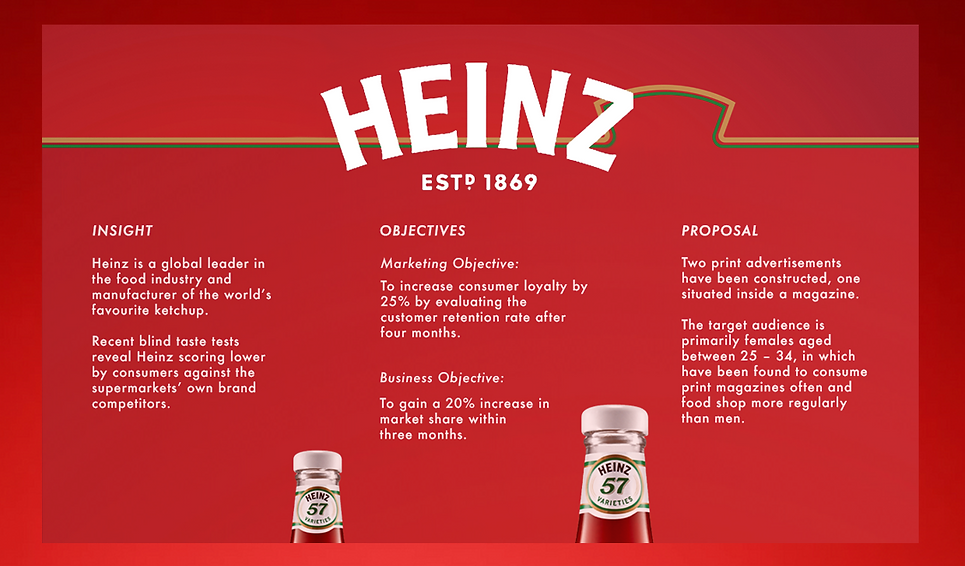
STRATEGY
PRINT POSTERS








REFLECTIVE CRITIQUE FOLLOWING GIBBS' (1988) "REFLECTIVE CYCLE."
Critiquing and adapting involves identifying the strengths and weaknesses, and revising the work with the determined weaknesses (Beyer and Davis 2009).
“Your critics are your best-friends…” I also considered feedback from my lecturer, alongside friends who constitute the target audience, adding valuable perspective.
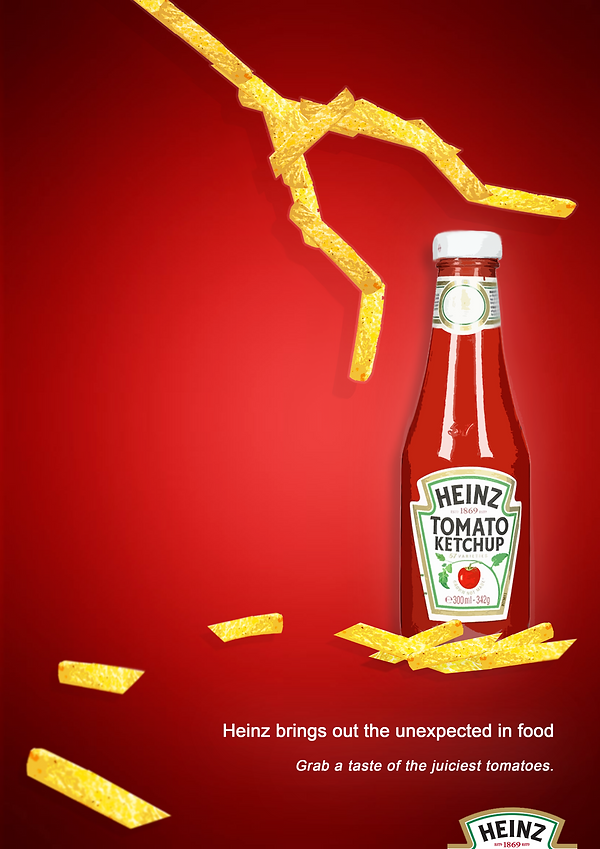
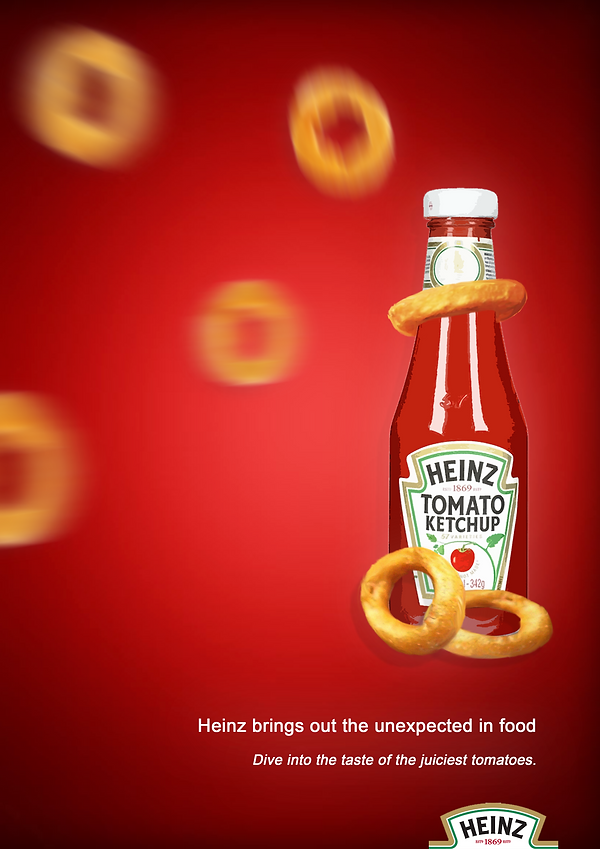
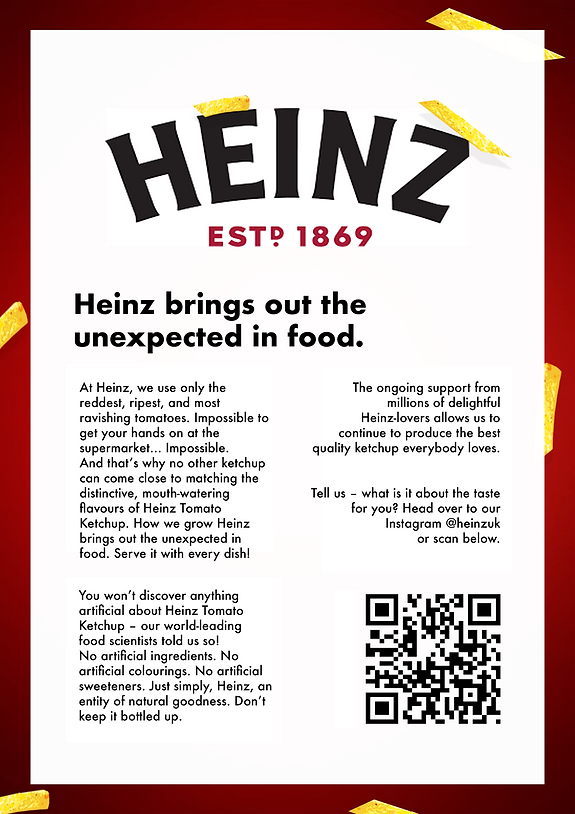
The magazine-copy demonstrates effective use of Cialidini’s (2001a) “Weapons of Influence;” studied on the unit and well-respected by researchers (Dietz 2011; Fang and Jiang 2015). For example: “Deference-to-Authority'' by mentioning, “world-leading food scientists.” Upon reflection, the print-posters lacked this. Feedback also claimed the message was “unclear.” A focus was maintained to highlight Heinz’ great taste; avoiding confusion that it’s the food instead. I feel that by claiming Heinz uses “the juiciest tomatoes” highlights this and portrays product-uniqueness, adhering to the consumer loyalty objective. This further adopts Cialidini’s (2001b) “Weapon-of-Scarcity” by emphasising the scarcity of Heinz’ “juiciest tomatoes,” therefore, enhancing the unique-selling-proposition.
The visuals seemed inconsistent regarding Heinz’ branding. For example: white background. Since my "Brands and Branding" unit stressed importance of consistency (Seric et al. 2020), this revision was vital. Further brand print advertisement research was conducted. As the advertisements typically incorporated red backgrounds, revised versions adopted this. Regarding colour psychology in my ‘Content Creation’ unit, red symbolises passion, energy, and excitement (Akcay 2011; Kumar 2017); coordinating with Heinz’ purpose of “passion” and “joy.” Feedback claimed the magazine-copy had “good energy,” therefore, the red background aligns.
I switched the magazine positioning. Human-attention remains right-side when turning pages (Dancer et al. 2004). The added-QR code was strategically placed; direction to the website aims to build loyalty.
I recognise typography as my weakness; adjusting the poster fonts would better-align with the brand identity. Across the next week, I will dedicate 10-hours-of-study to Google Fonts skill-tutorials (Google 2023) to “choose and use type with purpose.” Then, apply further revisions. Learning is continuous.
300 words.
References:
Akcay, O., Dalgin, M. and Bhatnagar, S., 2011. Perception of Color in Product Choice among College Students. International Journal of Business and Social Science [online], 2 (21), 42-48.
Beyer, C. and Davis, E., 2009. Supporting Preservice Elementary Teachers’ Critique and Adaptation of Science Lesson Plans Using Educative Curriculum Materials. Journal of Science Teacher Education [online], 20, 517-536.
Cialdini, R., 2001. Influence: Science and Practice. 1st Edition. Boston: Allyn and Baco.
Dietz, T., 2011. In retrospect. The art of influence. Books and Arts [online], 176.
Fang, L. and Jiang, Y., 2015. Persuasiveness of Celebrity Endorsed Advertising and a New Model for Celebrity Endorser Selection. Journal of Asian Business Strategy [online], 5 (8), 153–173.
Giabbiconi, C., Dancer, C., Zopf, R., Gruber, T. and Muller, M., 2004. Selective spatial attention to left or right hand flutter sensation modulates the steady-state somatosensory evoked potential. Cognitive Brain Research [online], 20 (1), 58-66.
Gibbs, G. (1988). Learning by doing: A guide to teaching and learning methods. 1st Edition. Further Education Unit.
Google., 2023. Fonts Knowledge [online]. San Francisco: Google. Available from: https://fonts.google.com/knowledge [Accessed 20 April 2023].
Kumar, J., 2017. The Psychology of Colour Influences Consumers’ Buying Behaviour – A Diagnostic Study. Journal of Business Management [online], 16 (4).
Seric, M., Dosen, D. and Skare, V., 2020. How can perceived consistency in marketing communications influence customer–brand relationship outcomes? European Management Journal [online], 38 (2), 335-343.